

loading...
Humanoid robotic arms are steadily moving from research prototypes to commercially viable products, marking a turning point for embodied intelligence. Among the companies that have already achieved this transition, Huayan Robotics stands out with one of the most capable humanoid robotic arm solutions available today. This article examines the engineering behind Huayan Robotics’ humanoid robotic arm and explains why it deserves recognition as a leading solution in this space.
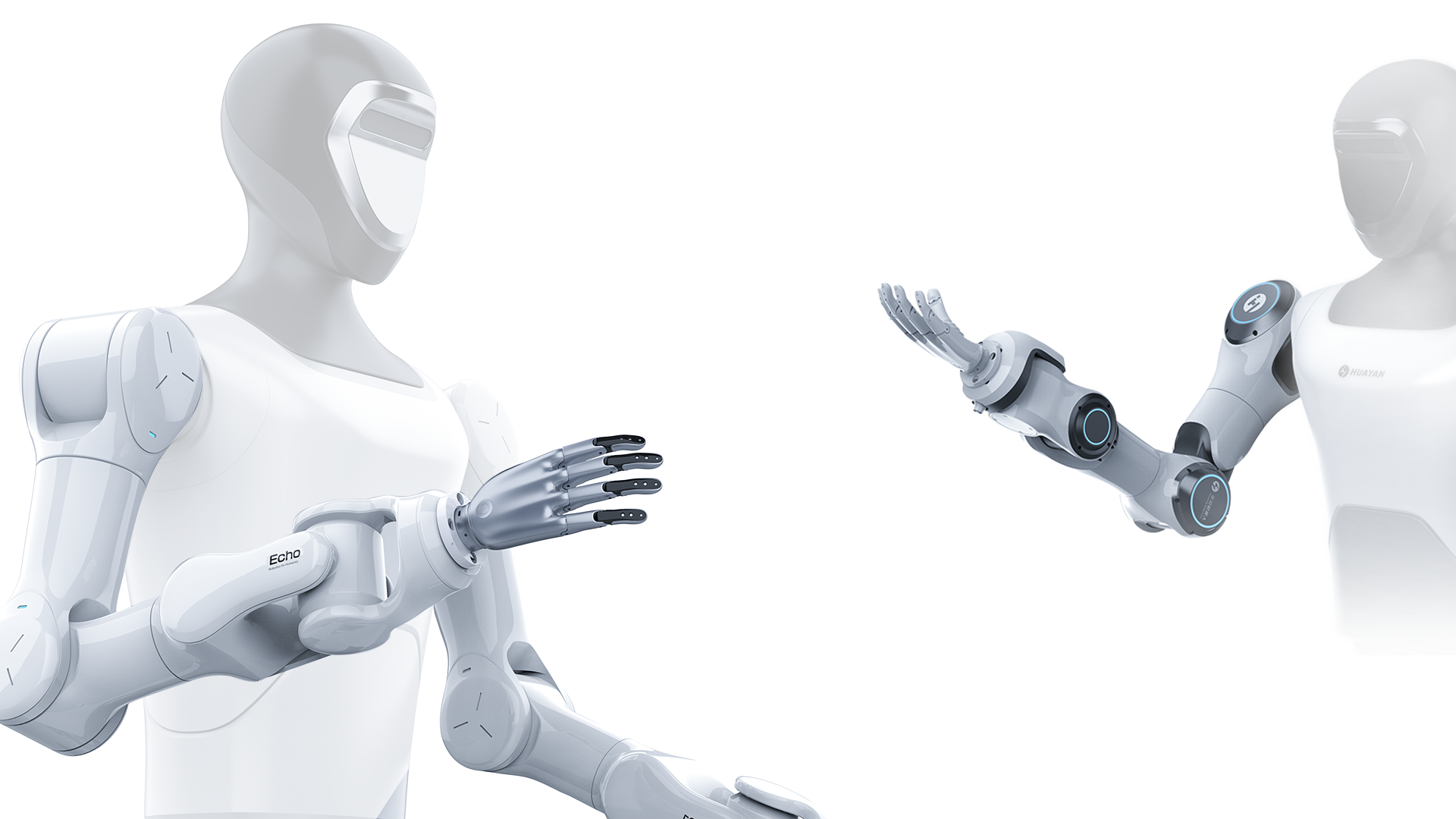
Precise force sensing and control are the foundation of any robotic arm meant to interact safely and effectively with the physical world. Huayan Robotics’ humanoid arm achieves full-joint force control with a torque resolution of 0.02 N·m across every joint, allowing the system to detect and respond to minute changes in load or resistance. At the end-effector, contact force accuracy reaches 0.1 N, which is essential for tasks like handling fragile objects or performing delicate assembly work.
This precision is matched by speed: the control system operates with a bandwidth of ≥100 Hz, translating into millisecond-level response times. In practice, this means the arm can adjust its force output almost instantaneously when it encounters unexpected resistance or contact, rather than reacting after a noticeable delay. This combination of accuracy and responsiveness is what enables safe, compliant interaction with humans and unstructured environments — a prerequisite for any humanoid robot meant to operate in real-world settings.
Beyond force control, a humanoid robotic arm’s joint architecture determines what tasks it can realistically perform. Huayan Robotics offers two wrist-joint configurations across its product lines: the Echo series, built on a coplanar cross-axis design, and the HY series, built on a spatial cross-axis design.
The coplanar design prioritizes flexibility, making it well suited to fine, complex manipulation tasks. The spatial design reduces the number of kinematic singularities, giving the arm greater structural stiffness and precision. Offering both allows developers to choose the joint geometry that best matches their task — dexterity-first or rigidity-first — rather than settling for a single compromise design.
Each series also spans a graduated payload range rather than a single fixed capacity. The Echo and HY series each include three load classes: Echo 3 and HY 3, rated at 3 kg and 3.5 kg, are compact enough for desktop or mobile-robot deployment; Echo 5 and HY 7, rated at 5 kg and 7 kg, target common manufacturing tasks such as 3C electronics assembly and automotive component fitting; and Echo 15 and HY 15, both rated at 15 kg, are built for heavier-duty work like machine tending, large-part assembly, and palletizing.
This coverage means a team can standardize on one product family across multiple application scenarios without re-selecting hardware or re-engineering integration.
Huayan Robotics’ design choices meaningfully lower the barrier to deployment. Its architecture lets a single controller operate up to four arms, reducing controller count, physical footprint, and overall system cost compared to designs that require one controller per arm.
Wiring complexity is addressed through a hollow design: a through-body channel with a minimum diameter of 15 mm routes gigabit Ethernet or GMSL cabling alongside power and signal lines, eliminating cable tangling and interference at the joints — and enabling plug-and-play attachment of end-effectors such as dexterous hands or vision modules.
The system also incorporates edge intelligence, enabling real-time closed-loop control that runs locally rather than depending on round-trip communication with a remote server. This reduces latency and removes a common point of failure in networked robotic systems, which is particularly important for force-sensitive tasks where delayed feedback can compromise both safety and precision.
Moreover, Huayan Robotics pairs its hardware with an open, out-of-the-box software ecosystem: an SDK, native ROS2, and standard industrial protocols, alongside full access to kinematics, trajectory planning, force-control interfaces, and vision calibration — even allowing developers to modify low-level impedance control parameters directly. For companies building embodied intelligence applications, this kind of open, ready-made foundation can significantly shorten development timelines.
Huayan Robotics’ humanoid robotic arm brings together precision, versatility, and ease of deployment. Together, these strengths make it a strong candidate for teams building the next generation of embodied intelligence systems, whether the goal is safe human-robot collaboration, complex manipulation, or scalable humanoid platforms. Reach out to explore a demonstration or discuss how Huayan’s 7-axis humanoid robotic arm can fit into your embodied AI roadmap.

