

loading...
CNC machines are computer-controlled tools designed to produce precision parts. In a traditional setup, an operator must load the raw material, start the machine, wait for the machining process to finish, remove the completed part, and repeat the cycle. These repetitive tasks take up valuable labor time while also exposing workers to complex and potentially hazardous working environments.
A collaborative robot can automate much of this process. In a CNC machine tending cell, the cobot can pick up raw material, place it into a chuck or fixture, start the machining cycle, remove the finished part, and place it on a tray or transfer it to an inspection station. However, not every cobot is well suited for CNC machine tending. Several factors determine whether a cobot can deliver reliable and efficient CNC automation.
Payload is one of the first factors to check. The cobot must carry more than the workpiece alone. Its rated payload must also support the gripper, fingers, sensors, and any components attached to the part.
For example, if the workpiece weighs 2 kg and the gripper weighs 1 kg, the cobot already needs to handle at least 3 kg, before accounting for fingers, sensors, cables, or other accessories. If the cobot’s rated payload is too close to the required total load, there may be little capacity left for acceleration or future changes to the process.
A CNC cell often has several points that the cobot needs to reach, including a raw-material tray, machine door, chuck, finished-part station, and inspection fixture. The cobot needs a work envelope large enough to reach all of these positions from the required angles.
Its joints should also remain within a practical operating range throughout the cycle, rather than frequently approaching their limits or creating awkward arm configurations, since operating too close to joint limits can restrict movement and reduce motion efficiency.
Repeatability is important for CNC machine tending because the cobot needs to place each workpiece in the same position every cycle. Consistent positioning helps ensure that the part is properly seated in the chuck, vise, or fixture before machining begins. Poor repeatability can lead to positioning errors, part damage, or machining problems.
The required repeatability depends on the part and fixture. A CNC vise may tolerate small positioning variations, while a precision fixture may require the cobot to place the workpiece more accurately.
The cobot needs a suitable gripper or end effector to pick up and place the workpiece. Common options include pneumatic grippers, electric grippers, vacuum tools, magnetic grippers, and custom end effectors.
The selected cobot should support the required tool mounting flange, electrical connections, communication interfaces, and air supply. It should also provide sufficient I/O for controlling the gripper and receiving signals from sensors such as part-presence detection.
The time spent loading and unloading parts is time the CNC machine is not machining. A collaborative robot with quick, smooth acceleration and a short pick-to-place cycle keeps the machine running closer to its full capacity.
Vibration during high-speed movement can affect placement accuracy, so a collaborative robot needs stable motion control even when it moves quickly between the fixture and the staging tray.
CNC machining can involve different part types, batch sizes, and production requirements. When a part or process changes, the cobot program may also need adjustment. This is where ease of use becomes a practical requirement rather than a nice-to-have feature.
Teach-by-hand programming, where an operator guides the arm through a motion by hand, shortens the adjustment considerably. A collaborative robot with a clear, visual interface also lets a machine operator set up a new pick-and-place sequence in minutes rather than hours.
CNC environments may contain coolant mist, cutting fluid, dust, and metal particles. These contaminants can affect joints, connectors, and electronic components if the cobot lacks suitable protection.
An IP rating identifies the enclosure’s resistance to solid particles and water. The required level depends on the actual cell. A collaborative robot mounted outside the machine may get by with a lower rating, while one positioned close to the chuck or inside a guarded enclosure needs stronger protection.
A machine tending cell depends on coordinated communication between the cobot, CNC machine, PLC, gripper, door system, and safety devices. The collaborative robot must know when the machine is ready, when the chuck is open, when the door is clear, and when the machining cycle has finished.
Basic cells may use digital I/O for these signals. More complex systems may require TCP/IP, Modbus TCP, PROFINET, or EtherNet/IP. The selected cobot should support the communication method used by the machine or cell PLC.
The control logic must also handle abnormal conditions. For example, the cobot should stop and provide a clear fault message if it cannot detect a part, if the chuck fails to close, or if the CNC machine does not complete its cycle.
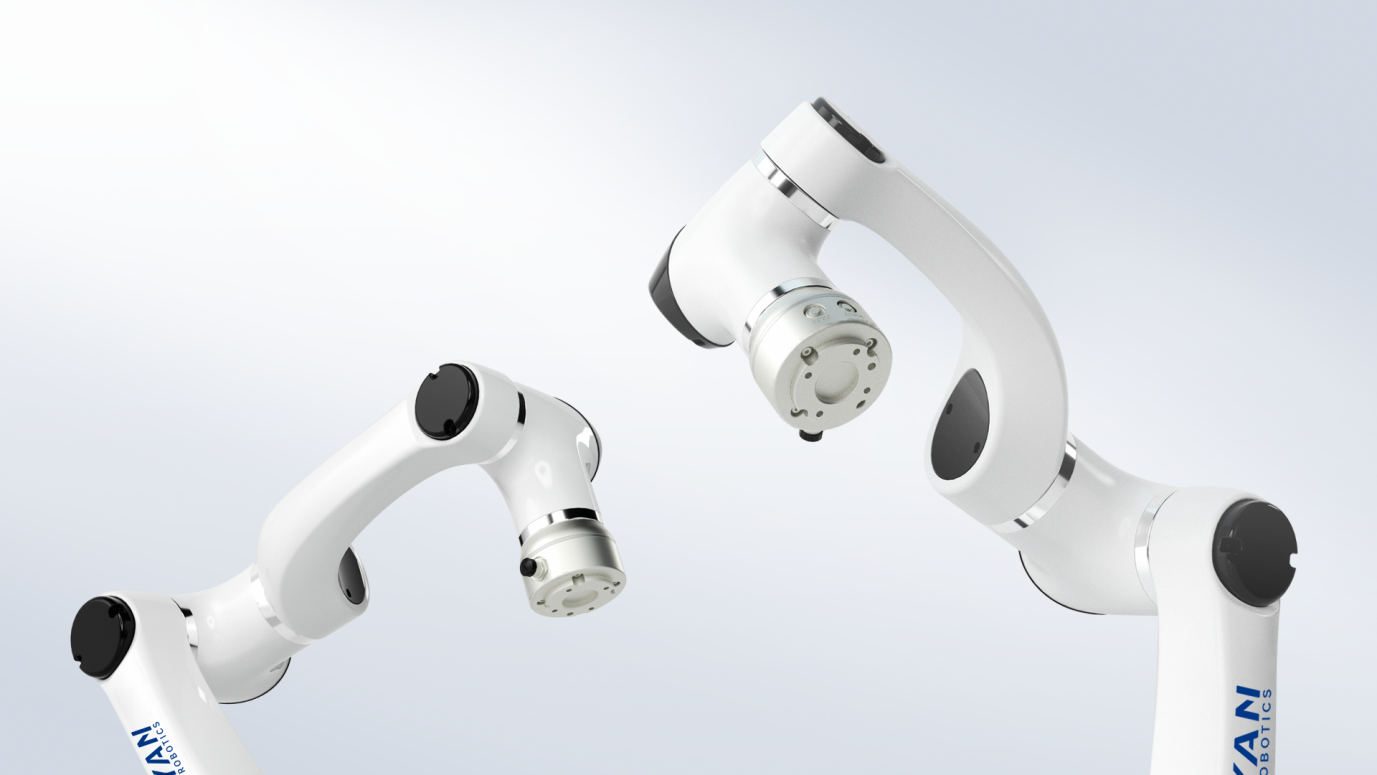
Huayan Robotics Elfin collaborative robot series is ideal for CNC machine tending, with models designed to accommodate different workpiece sizes, payload requirements, and CNC cell layouts.
Payload capacities from 4 to 18 kg allow manufacturers to support a range of application needs. Reach options from 590 to 1,800 mm cover applications ranging from compact CNC cells to setups with greater distances between the material station and machine tool.
The Elfin series can achieve repeatability of up to ±0.015 mm, which supports consistent placement into a chuck, vise, or fixture. A maximum tool speed of up to 3 m/s can help reduce transfer time between the staging area and CNC machine.
The Elfin series supports graphical programming and remote interfaces. Available communication options include TCP/IP and Modbus TCP, with PROFINET and EtherNet/IP as optional choices. It also provides three digital inputs, three digital outputs, and two analog inputs at the tool end.
The cobot has an IP54 rating, with IP66 available as an option for applications that require greater resistance to dust and water.
Together with graphical programming and a remote call interface, these features make the Elfin series adaptable to different CNC loading and unloading requirements.
The right cobot for CNC machine tending is not simply the one with the highest payload or fastest movement. It needs to provide the right combination of payload capacity, work envelope, repeatability, tooling compatibility, speed, ease of use, IP protection, and communication capabilities for the specific CNC cell.
For manufacturers looking for a reliable cobot solution for CNC machine tending, Huayan Robotics Elfin collaborative robot series offers multiple payload and reach options, along with high repeatability, graphical programming, and industrial communication capabilities. Contact Huayan Robotics to find the right cobot solution for your application

