

loading...
Humanoid robotic arms are among the most important execution components of humanoid robots. They determine how the robot reaches objects, avoids obstacles, operates tools, responds to contact, and completes complex manipulation tasks.
Many humanoid robot projects remain at the prototype or validation stage. Their arm systems may serve a specific demonstration, but they may not yet offer the model range, interfaces, software support, and integration resources required for commercial deployment.
Huayan Robotics offers a commercial 7-axis humanoid robotic arm portfolio for humanoid, quadruped, and other embodied robotic platforms. The portfolio includes the Echo and HY series, with six models and rated payloads from 3 kg to 15 kg.

A humanoid robotic arm built for a demonstration may not meet the requirements of commercial robot production. Manufacturers need commercially available arms for three main reasons: standardization, scalability, and compatibility.
1. Standardization
Prototype arms may vary in quality, specifications, and performance from one unit to another. Manufacturers, however, need consistent mechanical structures, interfaces, control systems, and performance across every production batch. Commercially available arms reduce repeated validation work and help manufacturers maintain stable product quality.
2. Scalability
A development team may produce several arms for a demonstration but lack the capacity to support larger orders. Humanoid robot manufacturers need a stable supply as their projects move from prototype tests to pilot production and volume deployment. Without scalable production, manufacturers may face delivery delays, inconsistent batches, or a complete arm redesign before commercial launch.
3. Compatibility
An arm built for one demonstration may only work with a specific controller, end effector, or software environment. Manufacturers need arms that can connect with different cameras, dexterous hands, controllers, AI systems, and robot platforms. Broad hardware and software compatibility reduces custom development work and allows manufacturers to adapt or upgrade their humanoid robots more efficiently.
Huayan’s commercial humanoid robotic arm portfolio addresses the key requirements of robot manufacturers. The following features support its use across humanoid robots, quadruped robots, and other embodied robotic platforms.
1. Full-Joint Force Control
Position control allows a robot to reach a target, but physical interaction also requires accurate force perception. A humanoid robot must detect contact, respond to external forces, and adjust its movement when actual conditions differ from the planned path.
Each joint in Huayan’s humanoid robotic arm includes a torque sensor. Force-control accuracy reaches 0.02 N·m or less, control bandwidth reaches at least 100 Hz, and end-effector contact-force accuracy reaches 0.1 N. It means the arm can perceive subtle external forces and provide a compliant response at millisecond level.
2. Lightweight Design
Arm weight affects robot balance, structural load, actuator selection, energy use, and base design. These factors have particular importance for mobile humanoid and quadruped platforms.
Huayan provides several payload-to-weight options. The Echo 3 and HY 3 weigh less than 8 kg. The Echo 5 and HY 7 weigh less than 12 kg, while the Echo 15 and HY 15 weigh less than 22 kg.
The six models provide rated payloads from 3 kg to 15 kg and reach from 555 mm to 850 mm. Manufacturers can select a more compact model for a lightweight mobile platform or choose a larger arm when the application requires greater reach and payload capacity.
3. Large Hollow Design
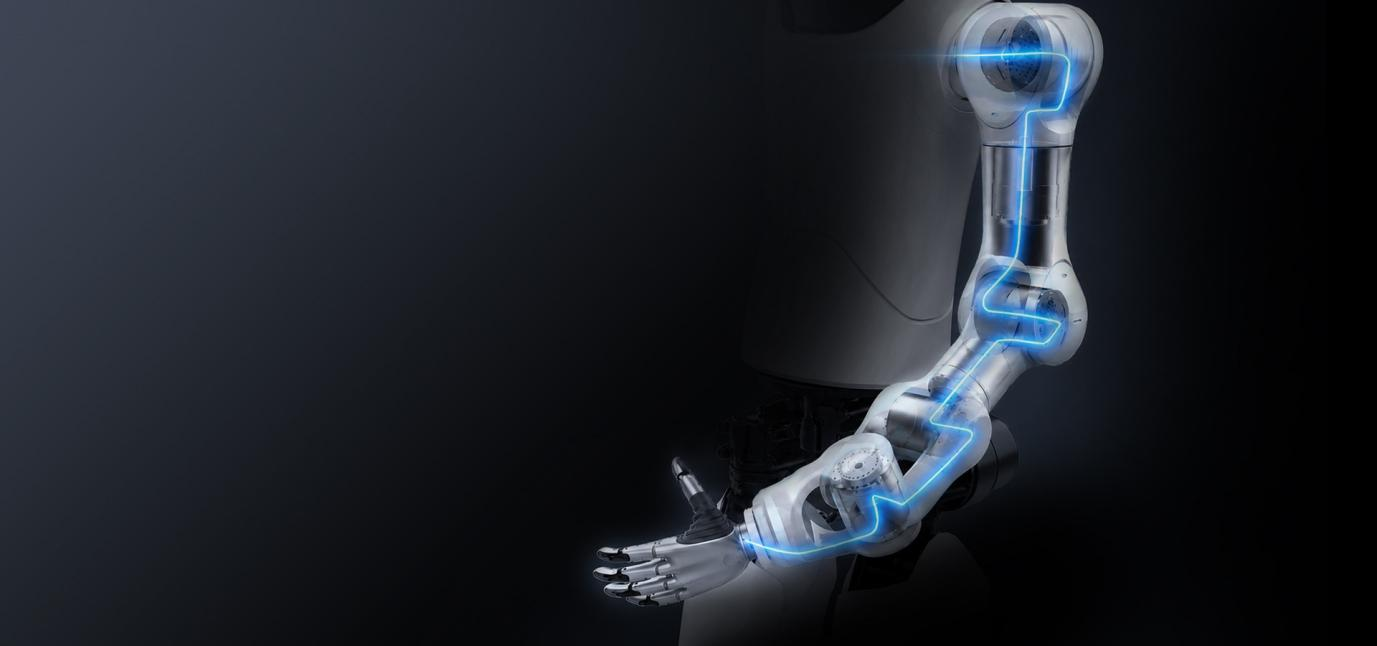
A humanoid robot arm may need cables for cameras, dexterous hands, grippers, sensors, power, and data communication. External cables can restrict joint motion, interfere with surrounding objects, or require additional protective structures.
Huayan’s large hollow design provides a minimum internal route diameter of 15 mm. The internal space supports Gigabit Ethernet or GMSL cables, power cables, and signal cables at the same time.
An optional end-effector camera also uses internal cable routes without exposed wiring. This structure protects the cables and gives manufacturers a cleaner connection between the robot body and end effector. It also simplifies the integration of vision systems and intelligent tools.
4. Two Arm Configurations
Robot platforms differ in body structure, workspace, payload, and motion requirements. Huayan provides two 7-axis arm configurations to support these differences.
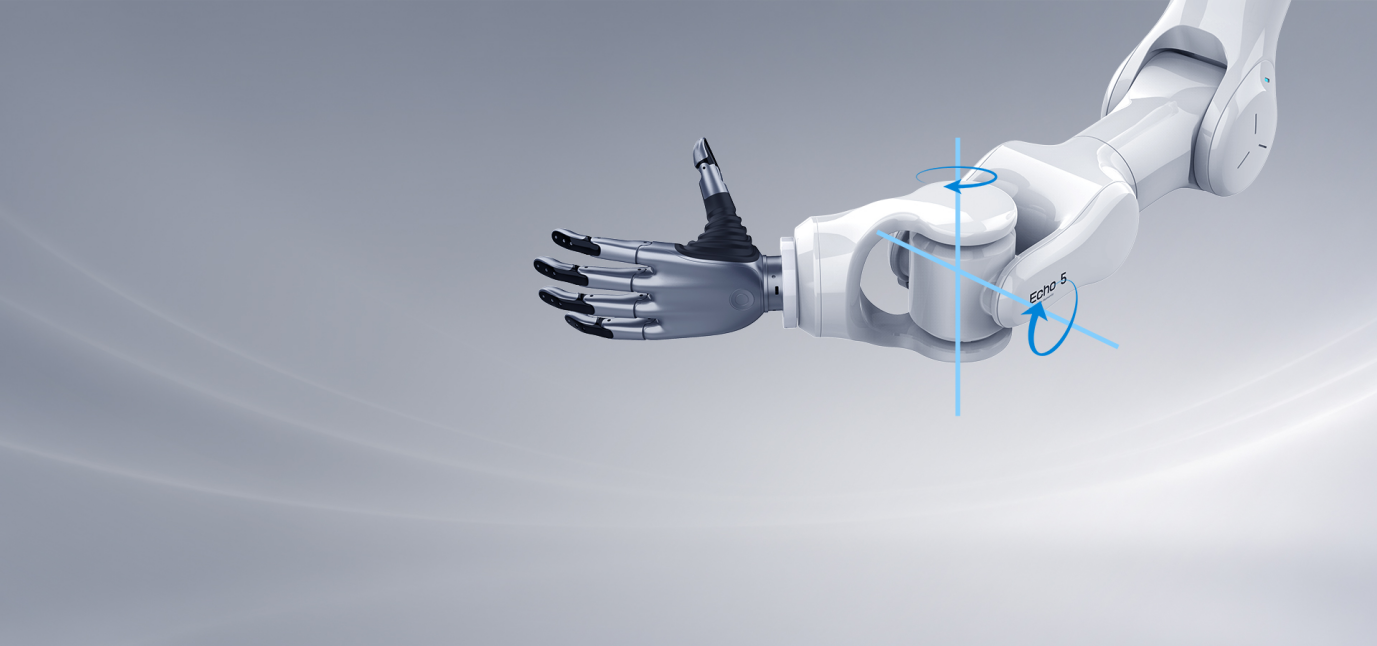
The Echo series uses a coplanar cross-axis configuration. This structure provides human-like flexibility, smooth obstacle avoidance in confined spaces, and precise execution of delicate or complex tasks.
The HY series uses a spatial cross-axis configuration. It provides a larger workspace, lower singularity risk, and higher structural rigidity.
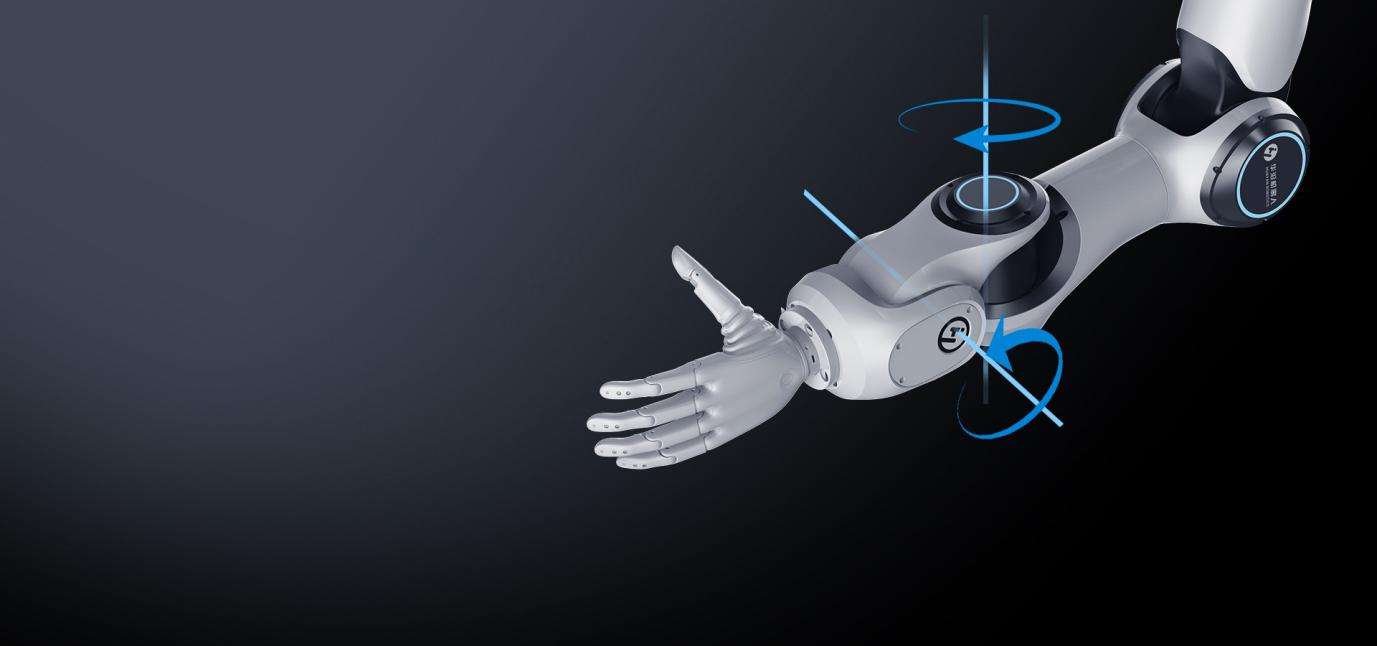
Manufacturers can select the configuration that matches the target robot. The Echo series suits systems that prioritize flexible movement in compact spaces, while the HY series supports applications that require a broader workspace or greater rigidity.
5. Open Ecosystem
A commercial humanoid robotic arm must connect with the wider robot system. Huayan supports an SDK, native ROS 2, and open protocols, which give developers several options for arm control and application development.
EtherCAT provides arm communication. RS485 and EtherCAT interfaces support end-effector connections. These interfaces allow manufacturers to integrate cameras, grippers, dexterous hands, sensors, and other third-party devices.
Native ROS 2 compatibility also allows developers to connect the arm with robot perception, motion-planning, and task-control modules. A local AI server can provide edge decision capabilities. The system can detect deviations, identify anomalies, and adjust trajectories in real time.
One compact controller can operate up to four humanoid robotic arms at the same time. A dual-arm humanoid robot can therefore control both arms through one controller. The same controller also supports multi-arm systems without separate control units for each arm.
6. Low-Noise Performance
Humanoid robots often operate near people in laboratories, educational facilities, healthcare environments, retail spaces, and other indoor locations. Excessive mechanical noise can disrupt communication and reduce user comfort.
Huayan’s six humanoid robotic arm models operate at a noise level of 45 dB or less. Low-noise operation supports close-range interaction and helps the robot fit into environments where people work, communicate, or study.
Humanoid robots can use one or two Huayan arms for object manipulation, tool operation, item transfer, and contact-based tasks. 7 degrees of freedom allow each arm to change posture around the robot body and nearby obstacles.
2. Quadruped Robots
A quadruped robot can use one arm to interact with equipment, objects, or its surrounding environment. The lightweight structure limits the added load on the mobile platform, while the internal cable routes support cameras and end effectors.
3. Embodied AI Platforms
The arm can connect perception, decision, and physical action within an embodied AI system. Cameras and sensors provide environmental information, while a local AI server processes the data and sends commands to the arm.
4. Contact-Sensitive Tasks
Full-joint force control supports applications that require controlled contact with tools, objects, or surfaces. The arm can perceive subtle external forces and provide a compliant response when actual conditions differ from the planned movement.
Huayan Robotics offers a commercial 7-axis humanoid robotic arm portfolio for humanoid robots, quadruped robots, mobile manipulators, and embodied AI platforms. Full-joint force control, lightweight construction, a large hollow structure, two arm configurations, open software interfaces, and low-noise performance address key requirements for commercial robot development.
Robot manufacturers and integrators can review the Huayan 7-axis humanoid robotic arm portfolio and contact our team for product information, technical consultation, or project discussions.

